School had a clock. You don't.
The timer is what made it frightening, and the timer is the first thing we removed. Numera has no countdowns, no speed rounds, and no "time's up" — nowhere in the app.
iPhone & iPad · in App Store review
Numera rebuilds your math from counting on to calculus — 268 lessons, ten minutes a day, at a pace that never once makes you feel slow. No timers. No scores. No red ink.
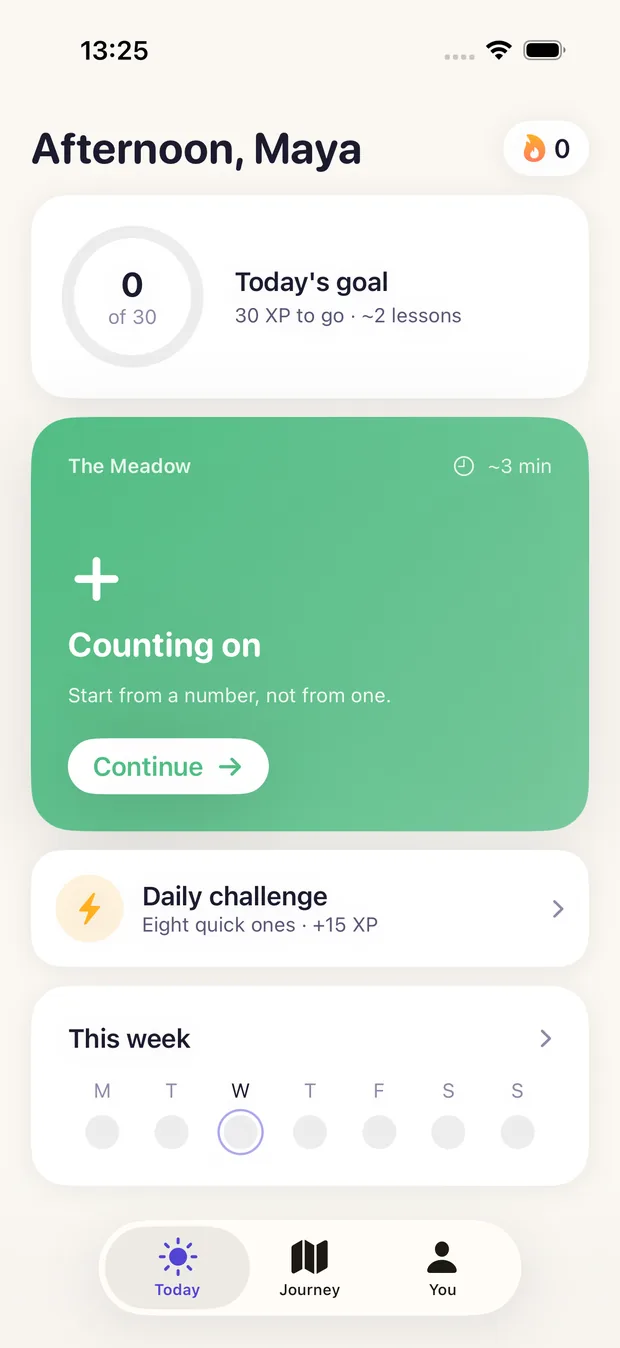
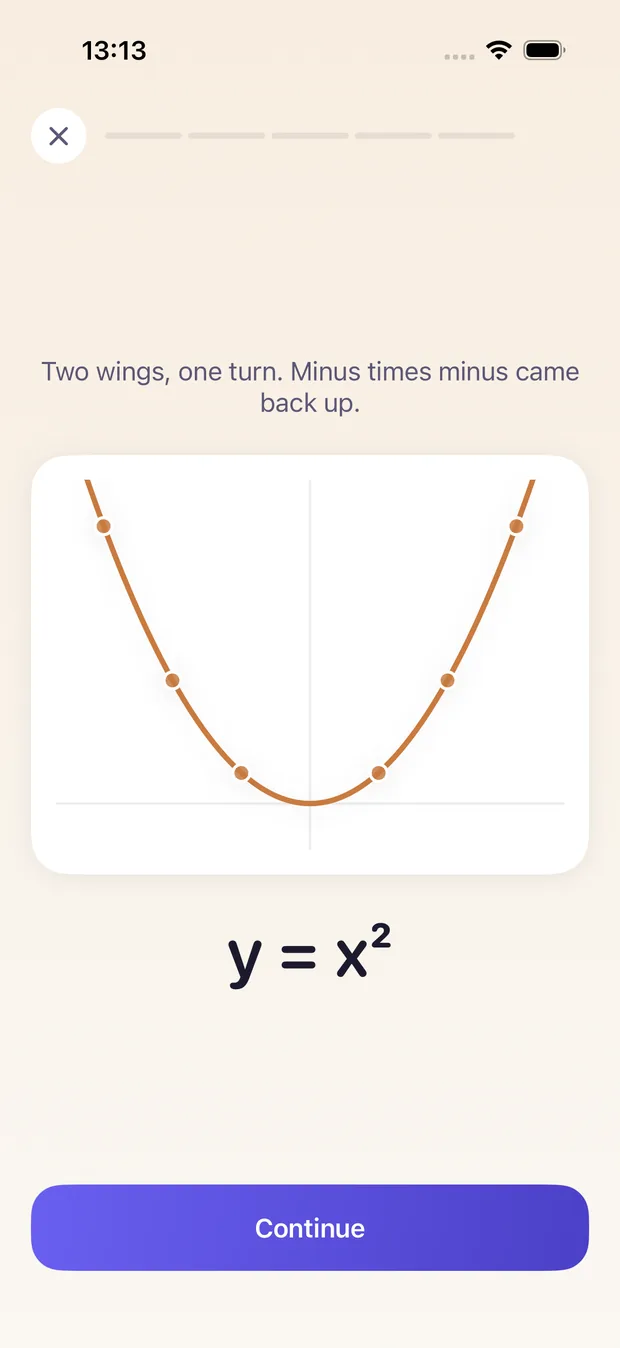
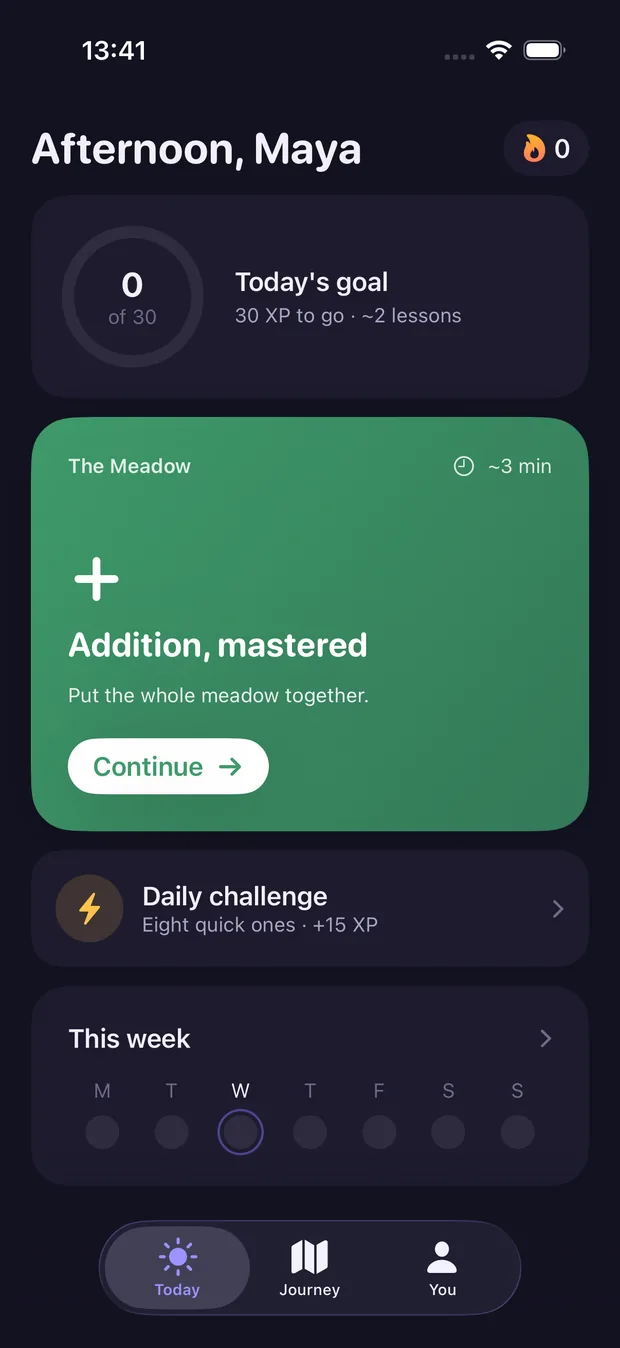
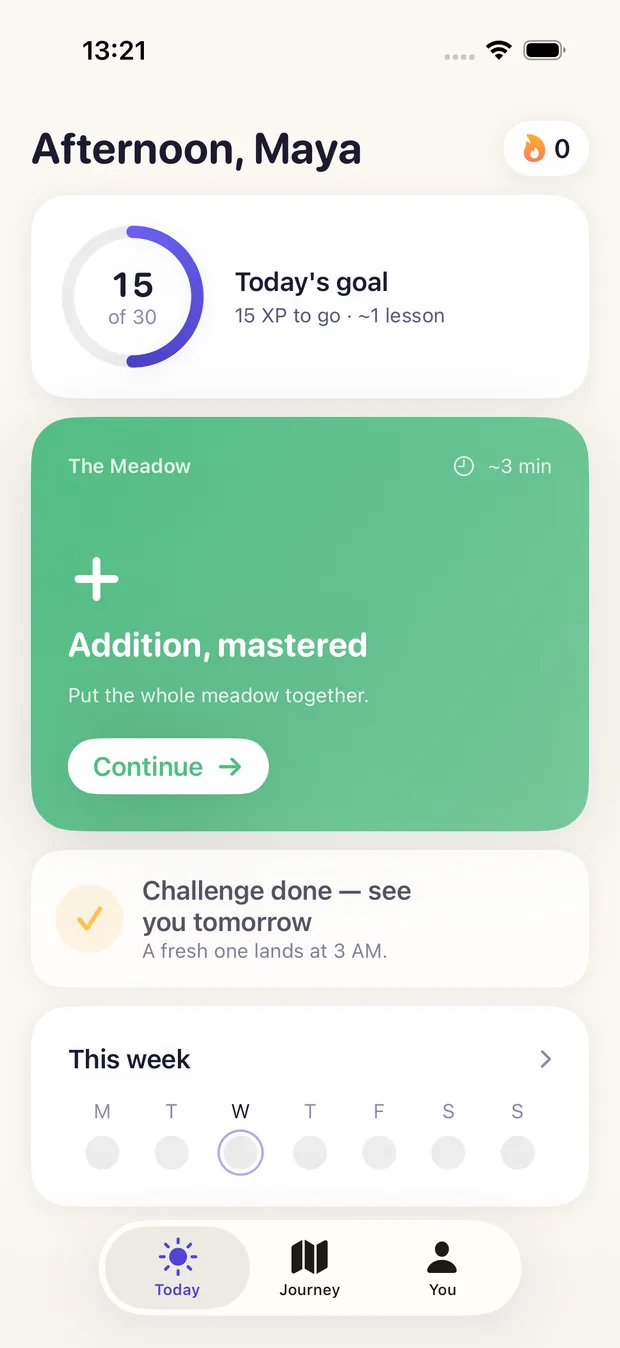
Today — one lesson, about three minutes.
Why this exists
Almost every adult who says "I'm just not a math person" is describing the same thing: one year where the class moved on and they didn't, and every year after that spent pretending. That gap never closes on its own — and it has nothing to do with how smart you are.
The timer is what made it frightening, and the timer is the first thing we removed. Numera has no countdowns, no speed rounds, and no "time's up" — nowhere in the app.
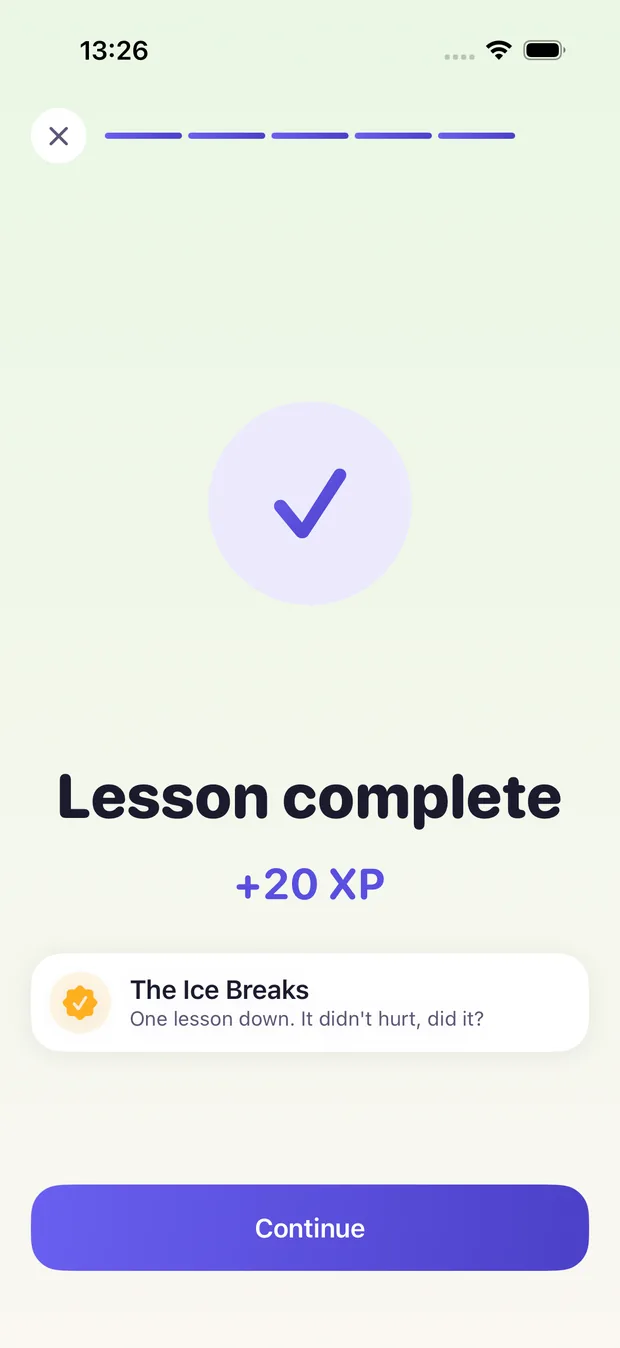
There is no red in a Numera lesson, and no answer is ever called wrong. Miss one and you get a warm retry, then a gentle reveal — and the lesson always ends on a right answer.
"Carry the one" is a rule you memorised. Numera shows you the tens actually regrouping, with dots you can move, before it ever asks you a question about them.
How it works
No setup marathon, no diagnostic exam, no placement score. Just a short conversation and then a first win.
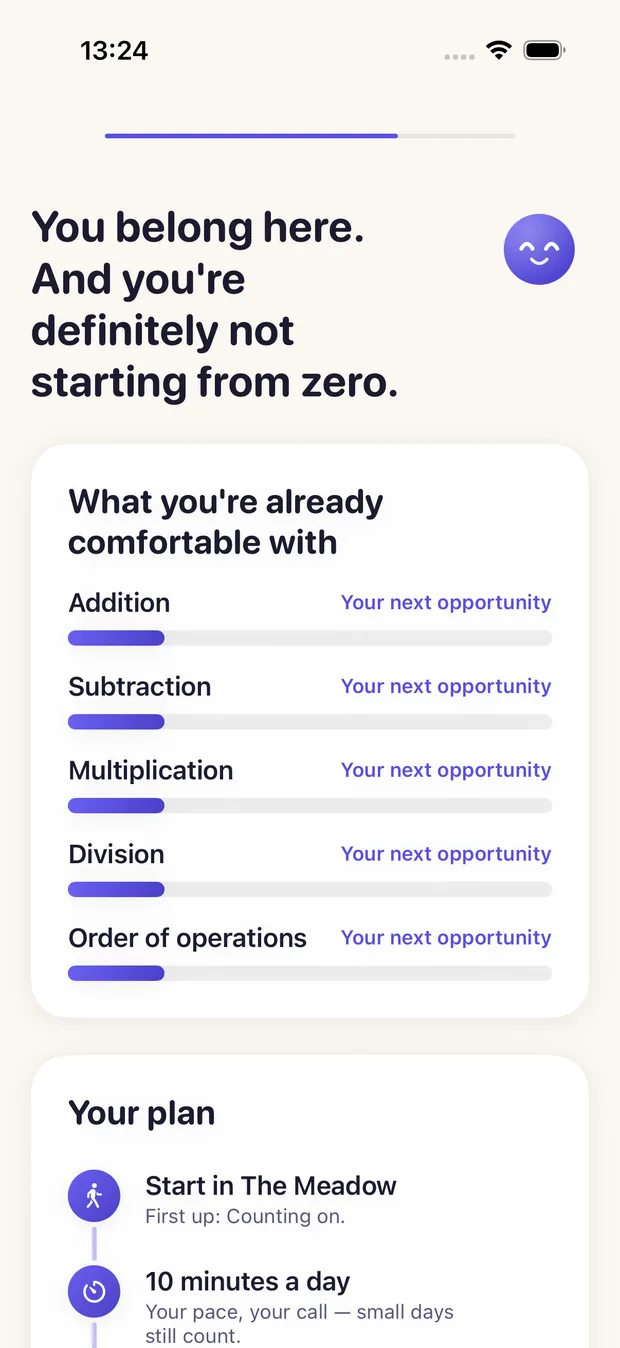
A handful of questions that adapt as you go — it is not a test, it is not scored, and you will never see a percentage. It exists purely so Numera knows which of the 26 regions to drop you into.
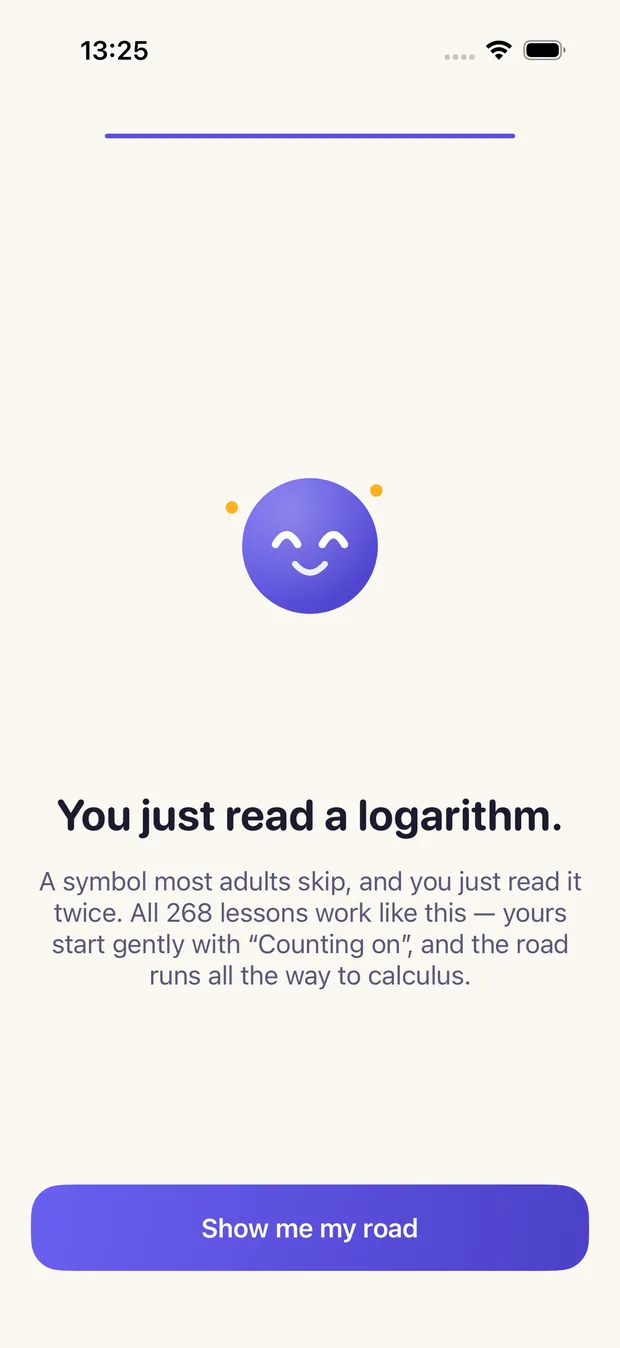
"You belong here. And you're definitely not starting from zero."
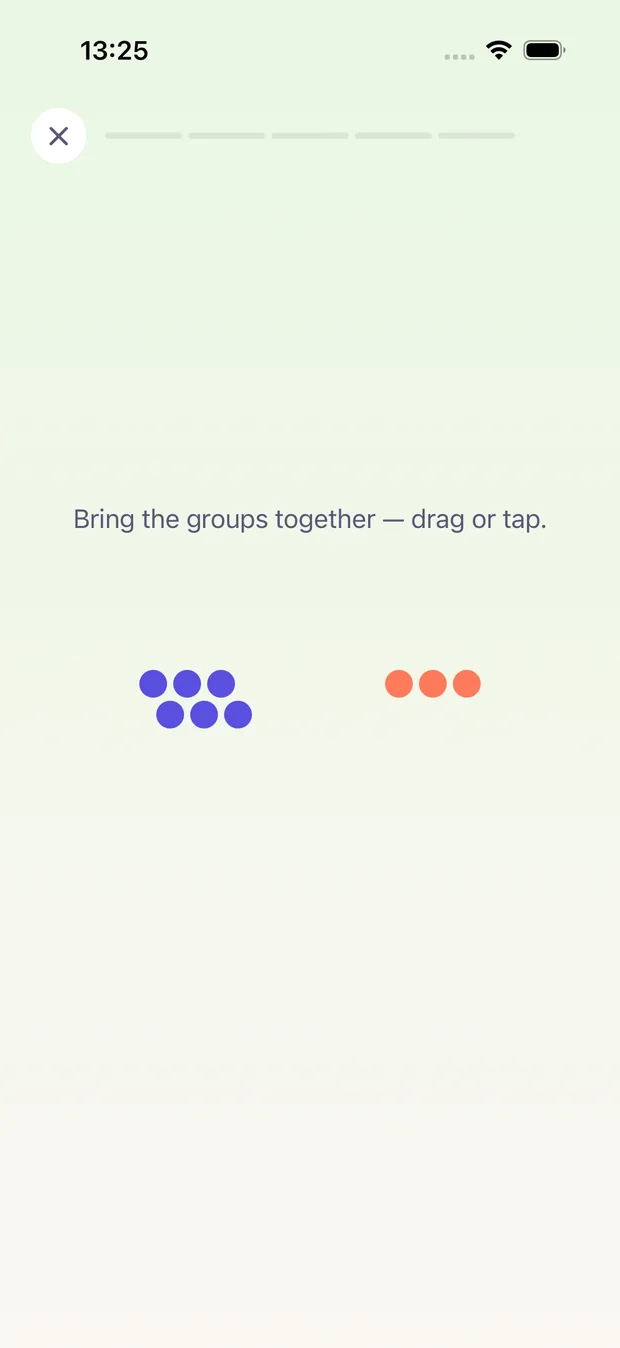
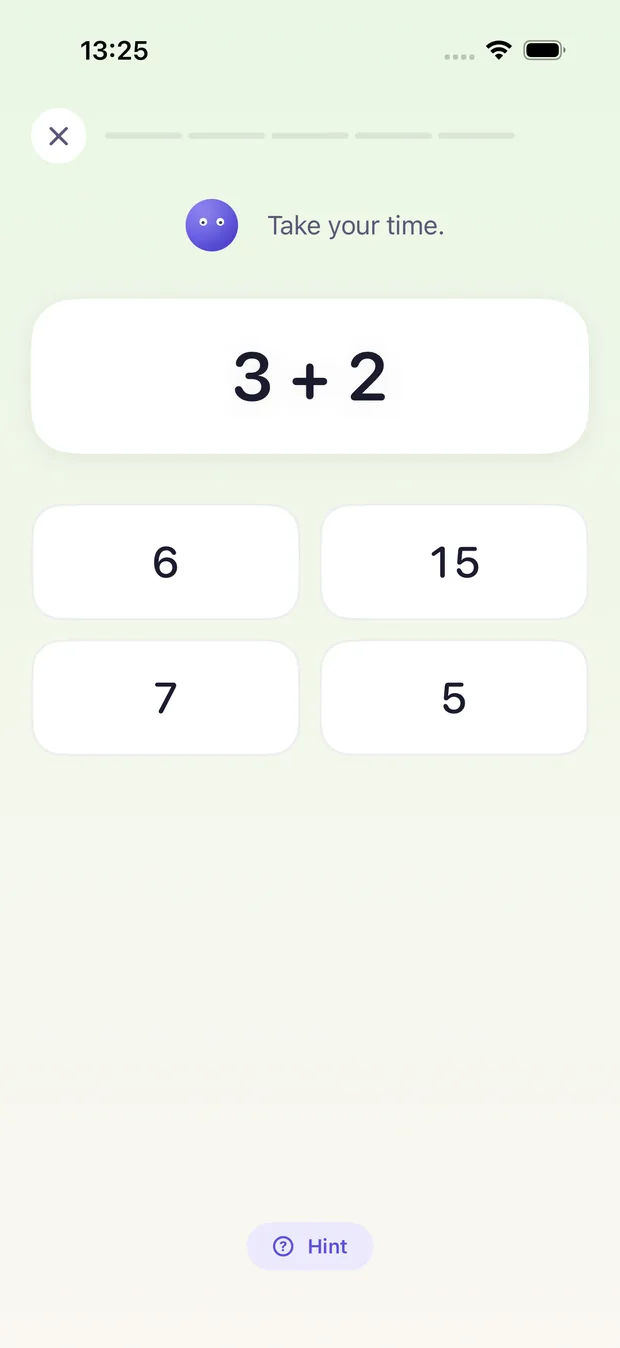
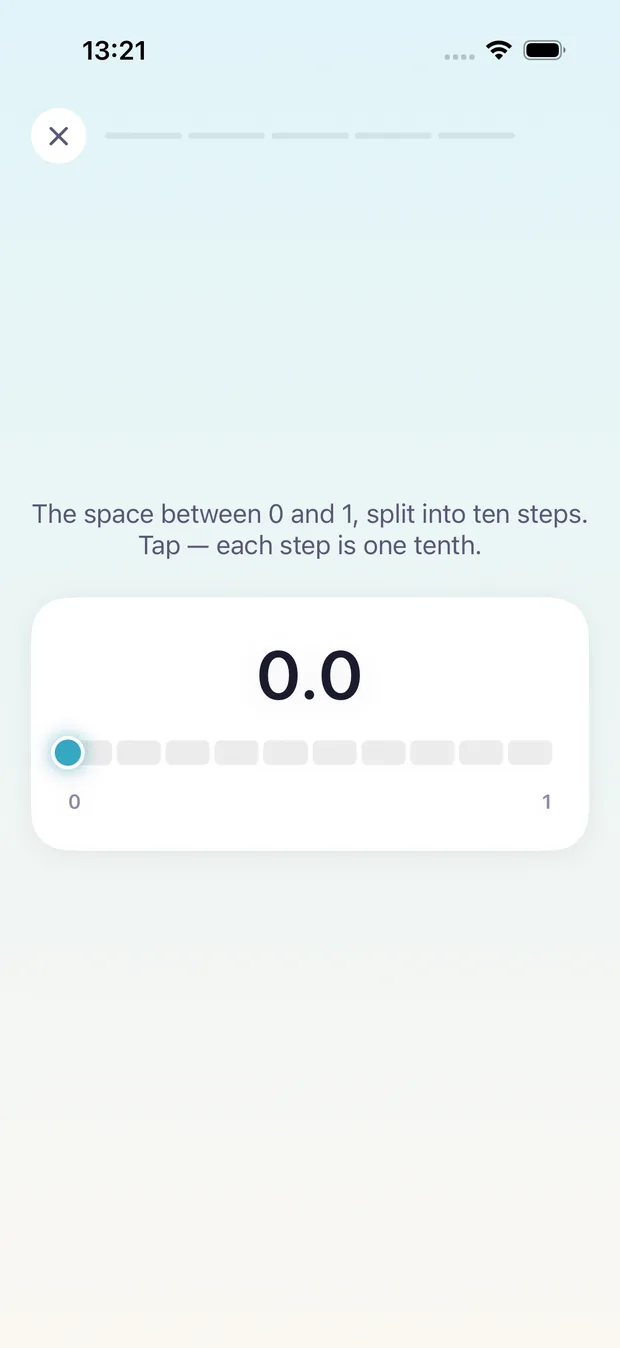
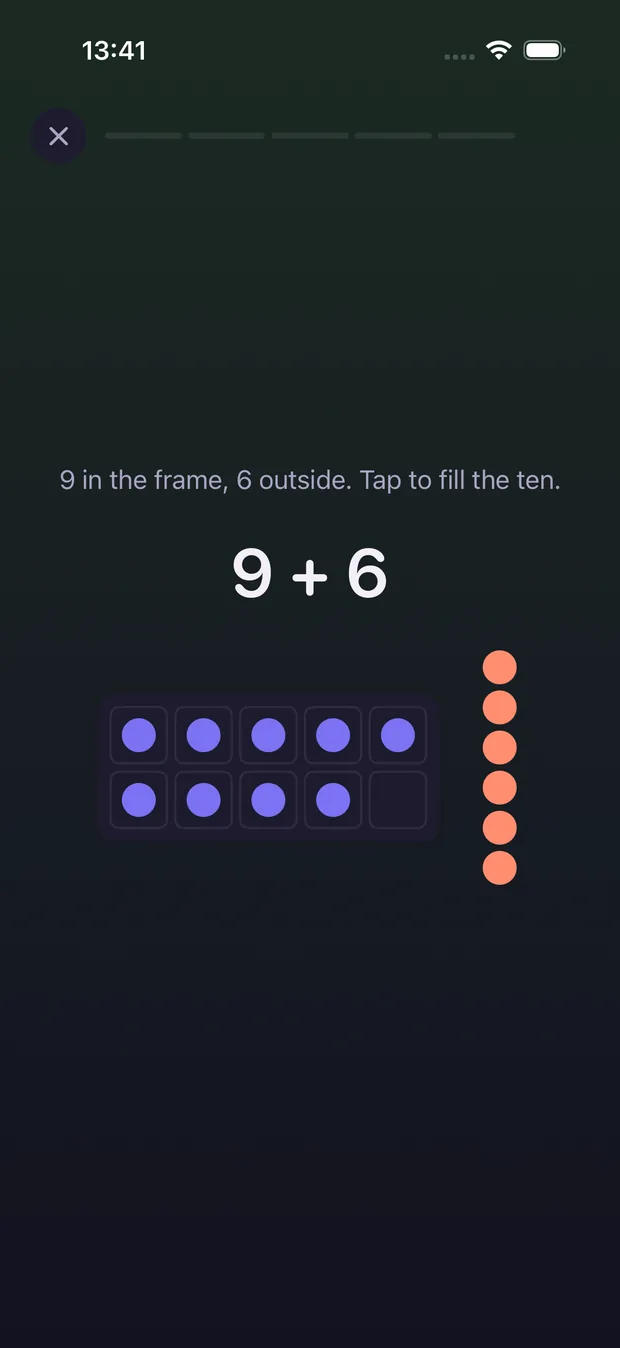
Every lesson opens with a thing that moves. Dots gather into tens. A number line stretches under a decimal. Tiles slide into a rectangle and become a product. You tap through at your own speed — there is no next button chasing you.
"Bring the groups together — drag or tap."
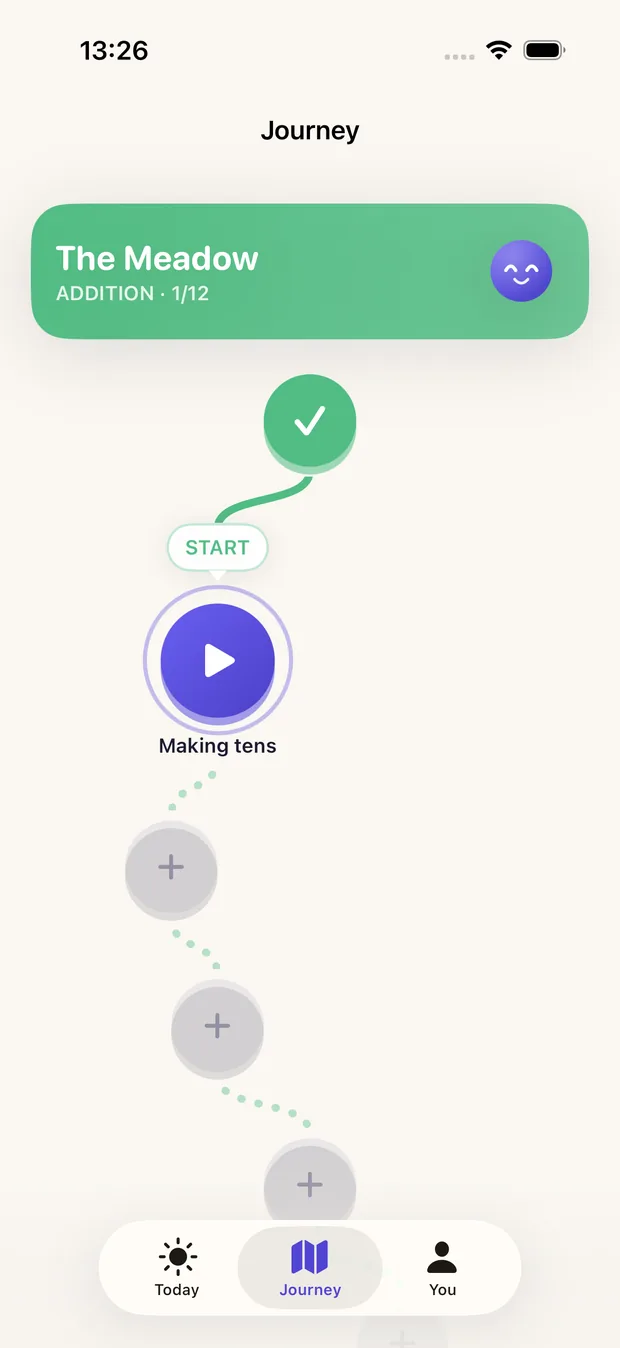
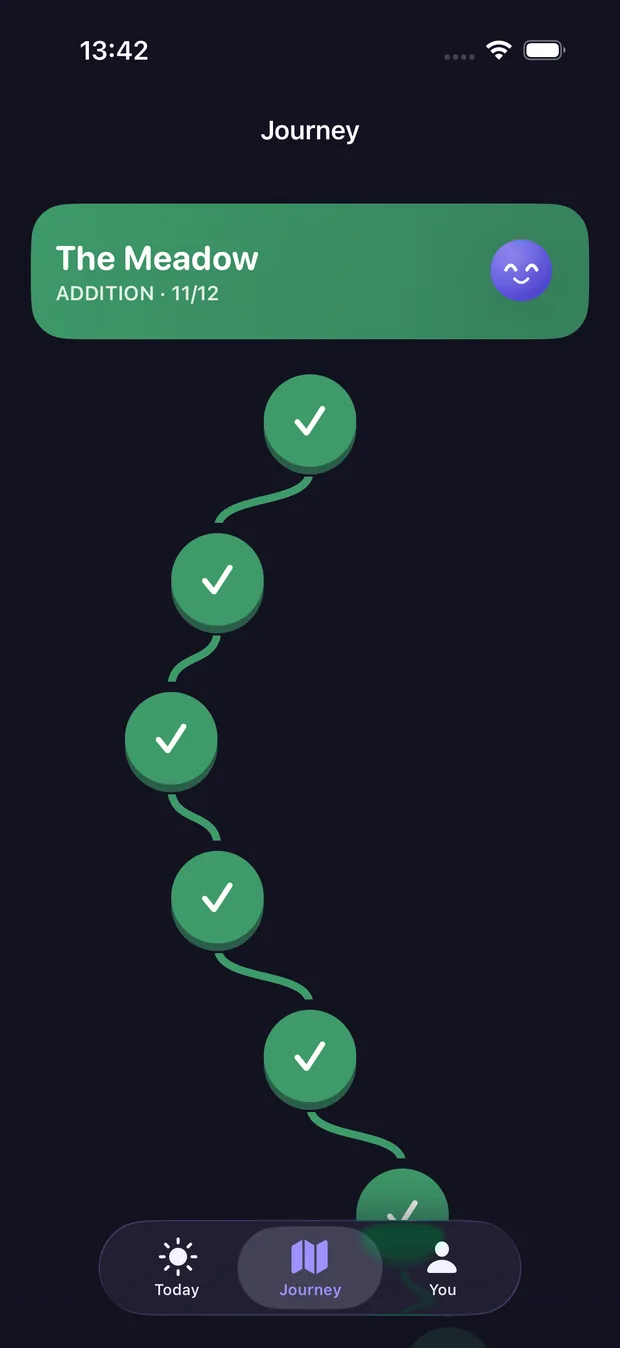
The Meadow, the Shore, the Forest, the Canyon, the Summit — and on through the Mist, the Observatory, the Cliffs, all the way to the Peak and the Valley where derivatives and integrals live. 268 lessons, each about three minutes, each ending on something you got right.
Small days still count. That's the whole streak policy.
Try it right here
"Making tens" — the second lesson in The Meadow, rebuilt for the browser. Roughly forty seconds.
Seven, and six more. Watch what happens.
10 + 3 = 13
Same choreography, same copy, same absence of a clock — 268 times over.
What's inside
Not in lessons, not in the daily challenge, not in the opening check. The pressure was never the point.
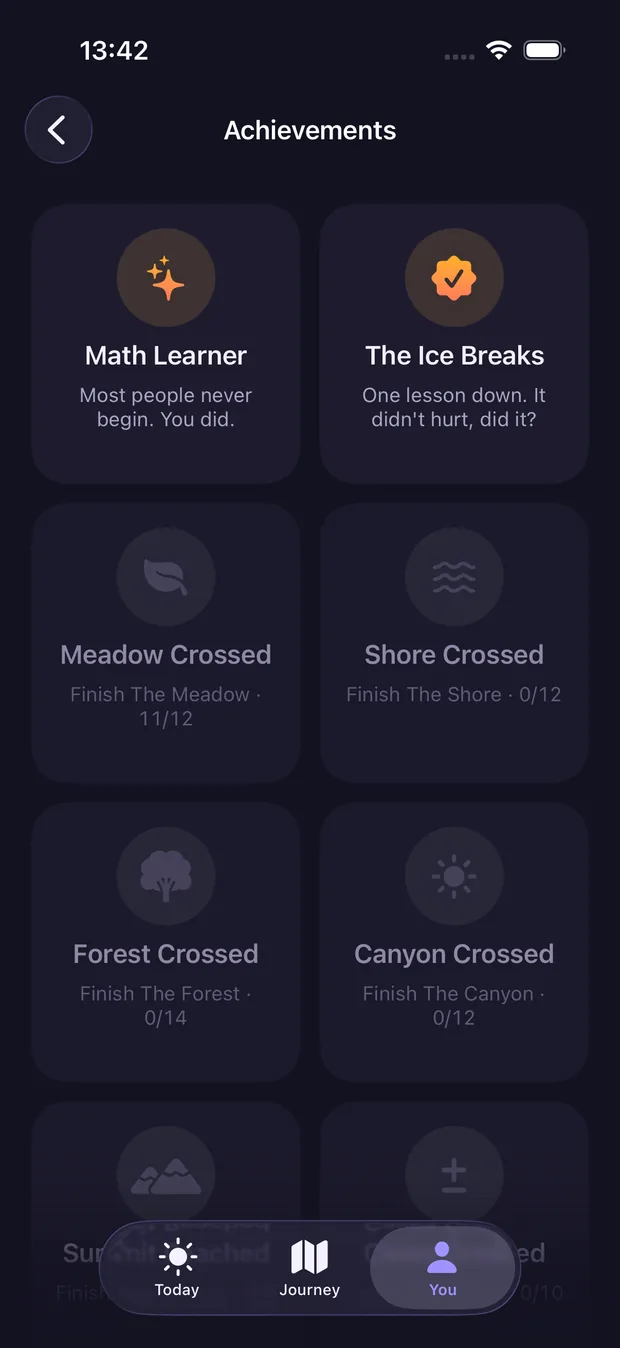
You never see a grade, a ranking, or a number that stands for how good you are. Progress is a map, not a mark.
Over forty hand-built visual explanations — dot fields, number lines, area tiles, unit circles, Riemann strips.
Warm retry, then a hint that dims two options, then a gentle reveal. Nothing is ever marked wrong.
Every fourth item is a real scene: a receipt, a tip, a discount, a dose, a map scale, a phone plan.
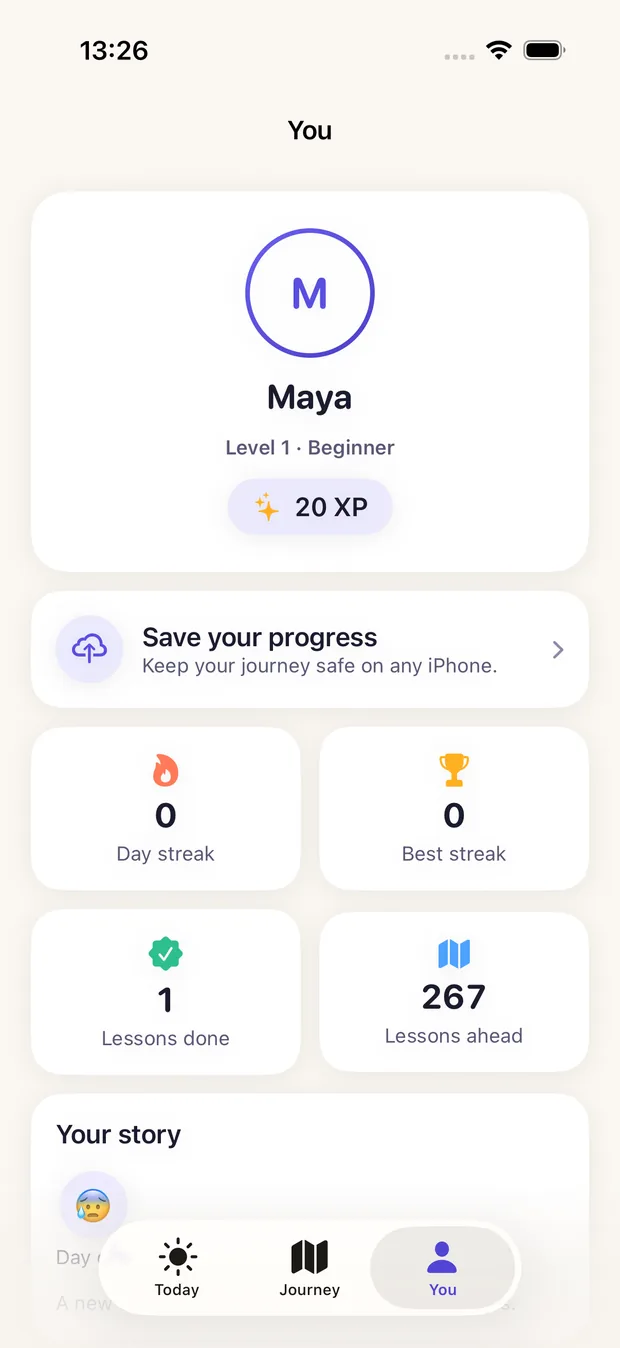
Shields cover the day life got in the way, and a five-minute day still counts. Streaks should not become a second source of dread.
Full dark mode, Reduce Motion, Dynamic Type and iPad layouts — every state drawn on purpose, not inherited.
Sign in with Apple or Google and your journey follows you to any iPhone or iPad. Or don't — the app works fully offline.
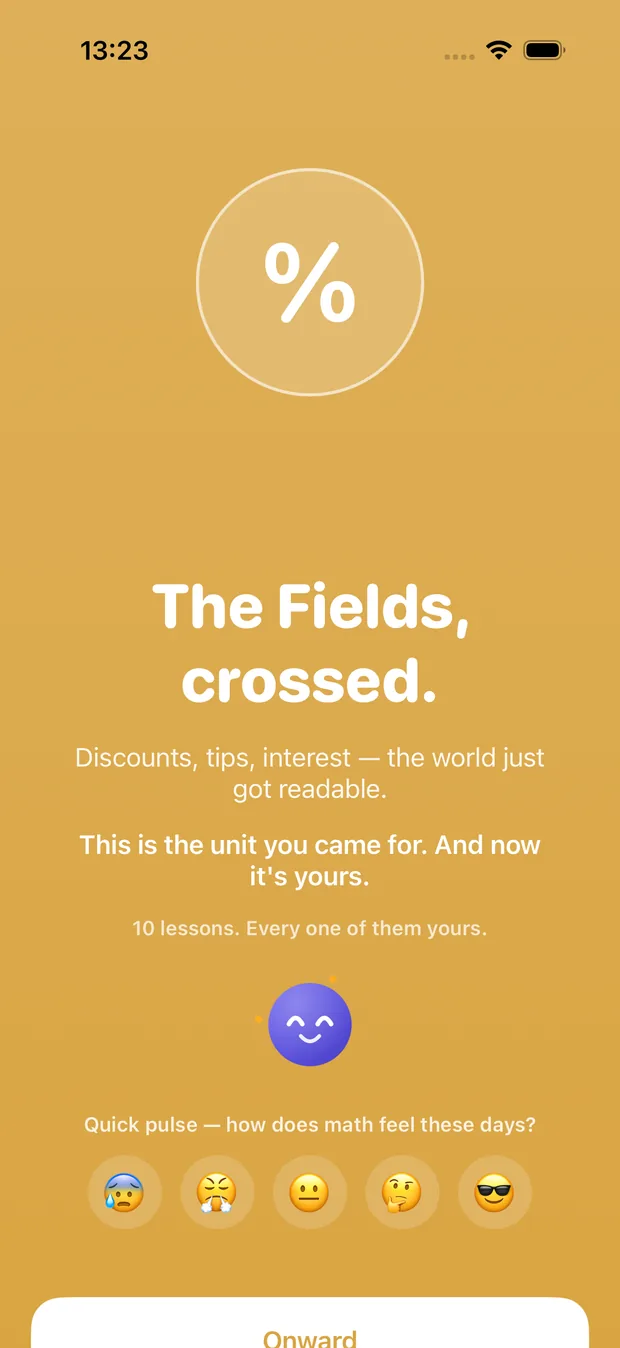
Numi is a calm circle with eyes. It notices when a lesson was hard. It never shouts, and it never guilt-trips.
The full route
Nothing is locked behind a level you have to grind for, and nothing skips a step. Functions, data and probability come before the calculus arc, because that is the order that actually makes calculus feel inevitable rather than impossible.
Inside the app
Questions
Yes — and usually faster than a child would. The bottleneck for adults is almost never ability; it is the pace of a classroom you left years ago, plus the fear it left behind. Numera starts at counting on and walks all the way to integrals, and it never moves faster than you do. If you want the long version, we wrote a step-by-step guide to relearning math as an adult.
It is the reason Numera exists. There are no timers, no scores, no percentages and no red ink anywhere in the app. Miss an answer and you get a warm retry, then a hint, then a gentle reveal — and every lesson ends on something you got right, by design.
The words matter too: nothing in Numera is ever called wrong, an error, or a failure. The opening check is called "finding your starting point," because that is what it is.
268 lessons across 26 units: addition, subtraction, multiplication, division, order of operations, negative numbers, fractions, decimals, ratios and proportion, percentages, shapes and space, coordinates, unknowns, functions, systems and inequalities, data and averages, probability, statistics, exponents, logarithms, quadratics, trigonometry, rates of change, limits, derivatives and integrals.
The full curriculum is public — every lesson title, in order.
No. The opening check finds where you already are and hands you a plan. It takes a couple of minutes and produces no score — just a starting region. And if you would rather choose for yourself, you can walk straight into any unit you like.
About three to five minutes. The default daily goal is ten minutes, which is roughly two lessons — and a shorter day still counts toward your streak. Numera would rather you come back tomorrow than finish a marathon today.
Numera is subscription-only: $7.99 a week, $14.99 a month, or $69.99 a year in the US. There is no free tier and no free trial — a deliberate choice, not a placeholder. Waitlist members hear about launch pricing before anyone else.
Numera is an iPhone and iPad app, built for iOS 26 and later. It is with Apple for App Store review right now. Join the waitlist and you get exactly one email — the day it goes live.
Those are genuinely good, and they are mostly built for people who already feel fine about math — learners who want breadth, puzzles, or a daily habit.
Numera is built for the adult who flinches. That single constraint decided everything: the absence of timers and scores, the warm-retry miss policy, the copy that never says "wrong", the fact that every lesson is engineered to end on a right answer. It is a smaller promise, kept very carefully.
It goes into a private list nobody can read from the outside, and it is used for exactly one message: launch day. No newsletter, no drip sequence, no sharing with anyone. Reply to that email with "remove" and it's gone.
Numera is in App Store review now. Leave your email and you'll hear the moment it's live — one message, then silence.